
The biggest Border Collie vs Australian Shepherd differences come down to work style and genes. Border Collies herd with an intense stare and a low crouch, while Aussies work upright, closer to the stock, and tend to be more protective. About half of Aussies carry the MDR1 drug-sensitivity gene, compared with under 5% of Border Collies.
Beyond that, the two breeds are close cousins in lifestyle. Both are medium-sized herding dogs with double coats, huge energy and sharp minds, and both live into their early teens. Here’s how they compare side by side, plus what to expect from a Border Collie Australian Shepherd mix.
Border Collie vs Australian Shepherd at a Glance
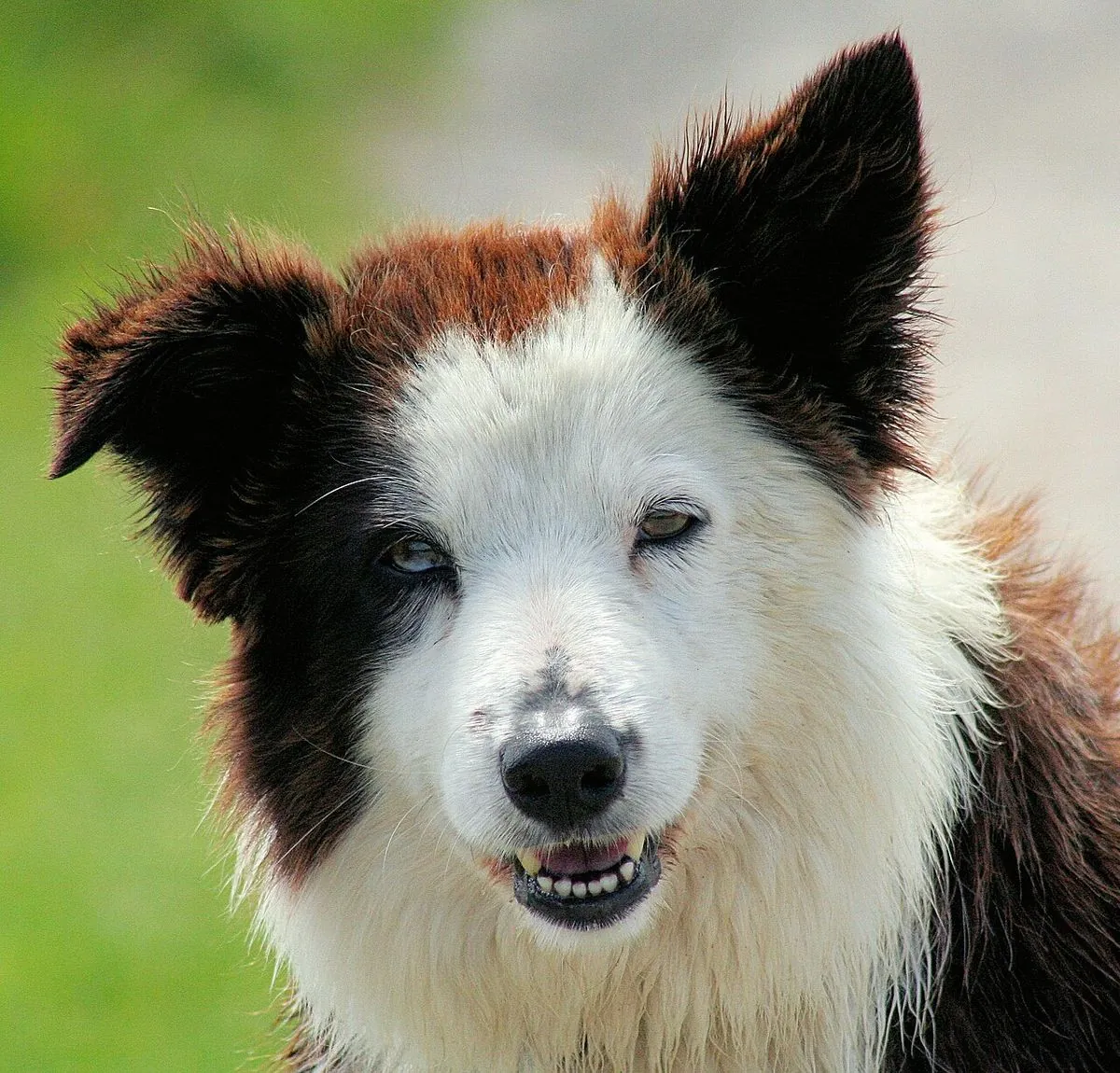
| Trait | Border Collie | Australian Shepherd |
|---|---|---|
| Origin | Anglo-Scottish border, Britain | California, United States (19th century) |
| Height | Males 19 to 22 in, females 18 to 21 in | Males 20 to 23 in, females 18 to 21 in |
| Weight | Males 31 to 55 lb, females 26 to 42 lb | About 35 to 70 lb overall |
| Coat | Smooth (short) or rough (medium), double coat | Moderately long, wavy double coat |
| Colors | Any color; black and white most common; tricolor, red, blue and lilac; merle possible but less common | Blue merle, red merle, black or red, with or without white and tan markings |
| Tail | Long, low-set | Long or naturally bobbed; docked in some countries |
| Median lifespan | 13.1 years (McMillan et al., 2024) | 13.7 years (McMillan et al., 2024, only 62 dogs) |
| Energy | Very high | Very high |
| Herding style | Strong eye, crouching, gathers stock | Loose eye, upright, close-working, may bark or grip |
| Trainability | Extremely high, very handler-focused | Very high, a bit more independent |
| Shedding | Moderate to heavy, seasonal blowouts | Moderate to heavy, seasonal blowouts |
| Breed-typical health issues | CEA, epilepsy, hip dysplasia, NCL, TNS, IGS, Border Collie Collapse | Hereditary cataracts (HSF4), CEA, epilepsy, MDR1, double merle defects |
| MDR1 mutation frequency (WSU) | Under 5% | About 50% |
| Kennel club recognition | FCI and UK Kennel Club; AKC in 1995 | UKC in 1979; AKC in the 1990s; FCI later |
What Is the Difference Between a Border Collie and an Australian Shepherd?
A Border Collie is a British sheepdog bred to gather flocks with a fixed stare, and an Australian Shepherd is an American ranch dog bred to move sheep and cattle with an upright, pushier style. Aussies are usually a bit heavier, fluffier and more wary of strangers. Border Collies are usually more intense and more tuned in to their handler.
These are tendencies, not rules, so meet the actual dog and its parents before you decide.
Origin and History: Britain vs the American West
The Border Collie comes from the hill farms along the border between England and Scotland. Farmers bred sheepdogs for working ability, not looks. A dog called Old Hemp, born in Northumberland in 1893, is credited as a foundation sire of the modern breed. You can read the full story in our Border Collie history page.
Despite its name, the Australian Shepherd isn’t from Australia. The breed was developed in California in the 1800s as a sheep-herding dog for western ranchers. Its ancestors likely included Spanish sheepdogs and collie-type dogs that arrived in shipments of sheep from Australia and New Zealand, which is where the name came from. Claims that Basque or Pyrenean dogs were the main ancestors are often repeated but not proven.
Aussies stayed a ranch secret until the mid-1900s, when rodeo performer Jay Sisler toured the western states with his trick-performing Aussies. The United Kennel Club recognized the breed in 1979. The Australian Shepherd entry on Wikipedia covers the history in more detail.
Appearance: Size, Coat, Colors and Tail
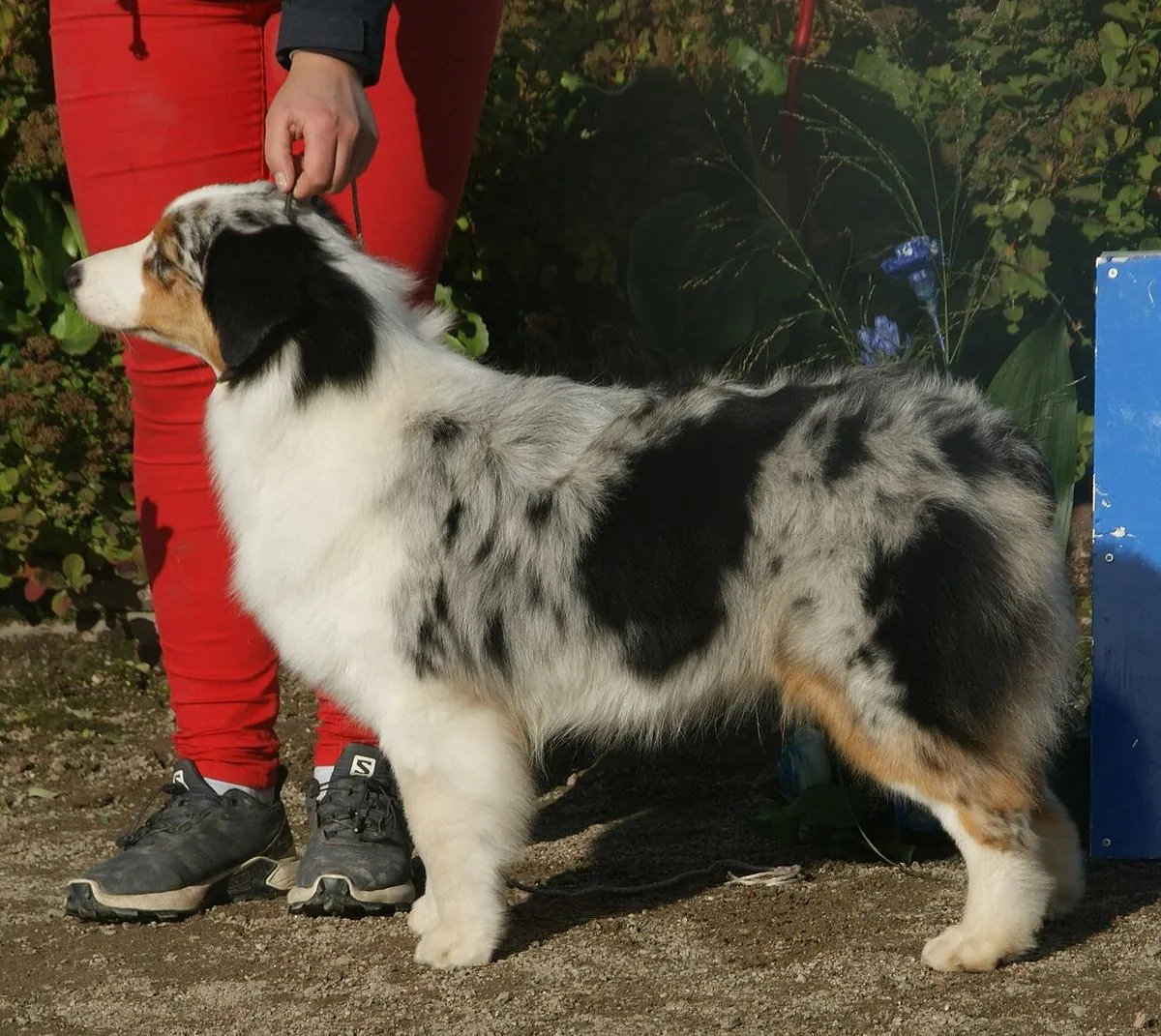
Side by side, an Aussie usually looks sturdier. It’s often a little taller and heavier, with a thicker, wavier coat and heavy feathering on the backs of the legs. A Border Collie looks lighter and more athletic, built to run all day on open hills.
Coat Types and Colors
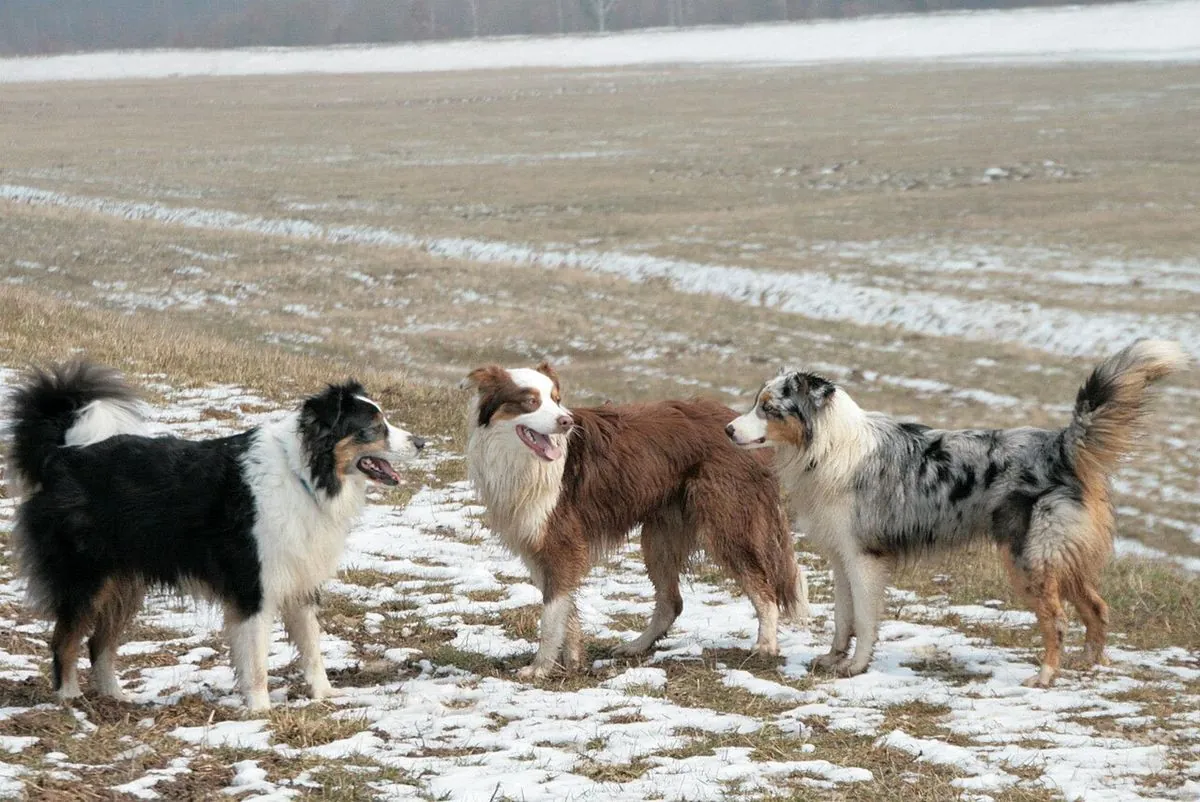
Border Collies come in two coat types. The rough coat is medium length with a mane and feathering, and the smooth coat is short all over. Almost any color is allowed, but black and white is the classic look, followed by tricolor.
Merle is where people mix the breeds up. Blue merle and red merle are the signature Aussie colors. Border Collies can be merle too, but it’s far less common, so a merle dog with a fluffy coat is more likely to be an Aussie or an Aussie mix. Blue eyes and odd-colored eyes show up in both breeds, mostly in merles.
Merle carries one real health warning. Breeding two merles together can produce “double merle” puppies, which are often mostly white and may be born deaf, blind or with malformed eyes. Good breeders of either breed never pair merle with merle.
Tails
The tail is a quick tell. A Border Collie always has a long tail carried low. Many Aussies are born with a natural bobtail, and in the US long-tailed Aussies have traditionally been docked. Some countries ban docking, so you’ll see more full-tailed Aussies in Europe.
Border Collie vs Australian Shepherd Personality and Herding Style
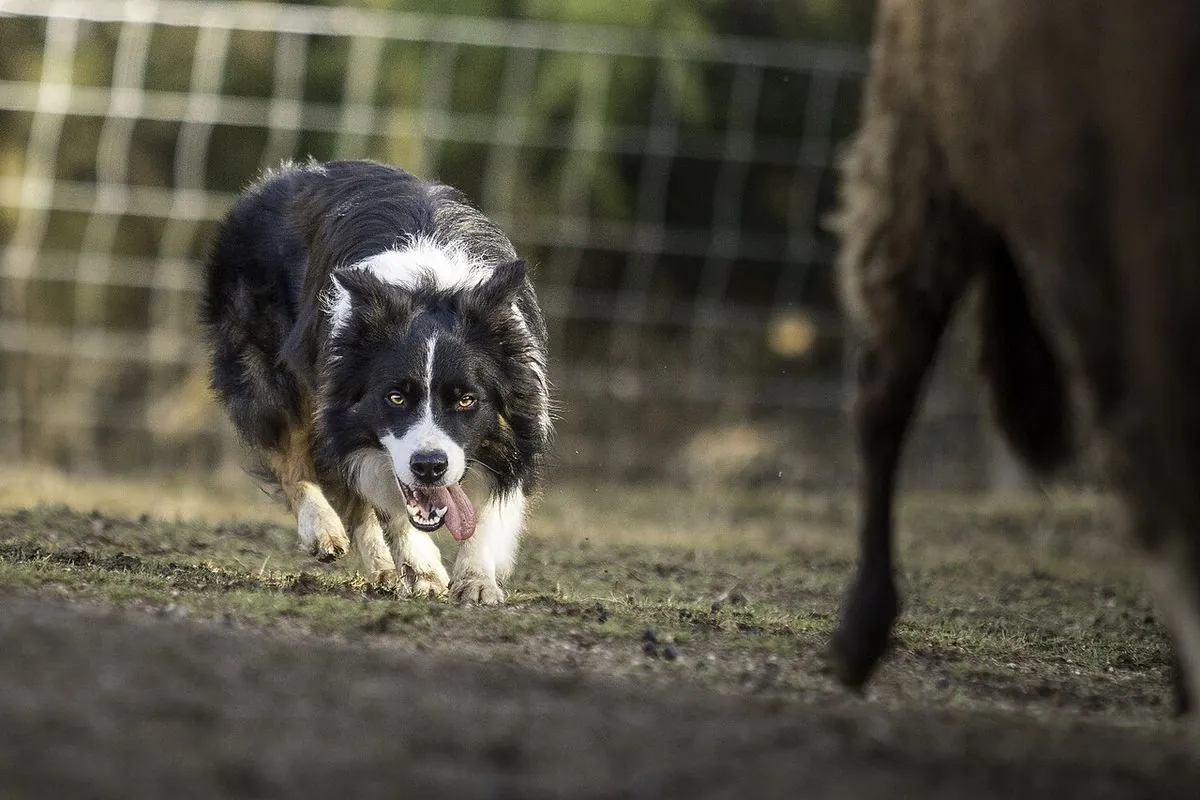
Border Collies are “strong-eyed” dogs. They drop into a crouch, lock onto the sheep with an unbroken stare and creep forward like a stalking predator. They excel at gathering a scattered flock and bringing it to the handler, often from far away by voice and whistle. At home that same focus shows up as staring at balls, shadows or the cat, and a strong pull toward their person.
Australian Shepherds are usually described as “loose-eyed.” They work standing up and close to the stock, using their presence and movement, and some use a bark or a nip at the heels to get stubborn animals moving. Aussies were bred as all-round ranch dogs, so many also have a guarding streak. They tend to be more reserved with strangers and quicker to alert to visitors.
Both breeds may try to herd kids, bikes and other pets, often with nipping. For a closer look at the Border Collie side, see our guide to Border Collie temperament. Aussies that use their voice on stock can be vocal at home too.
Energy and Exercise Needs
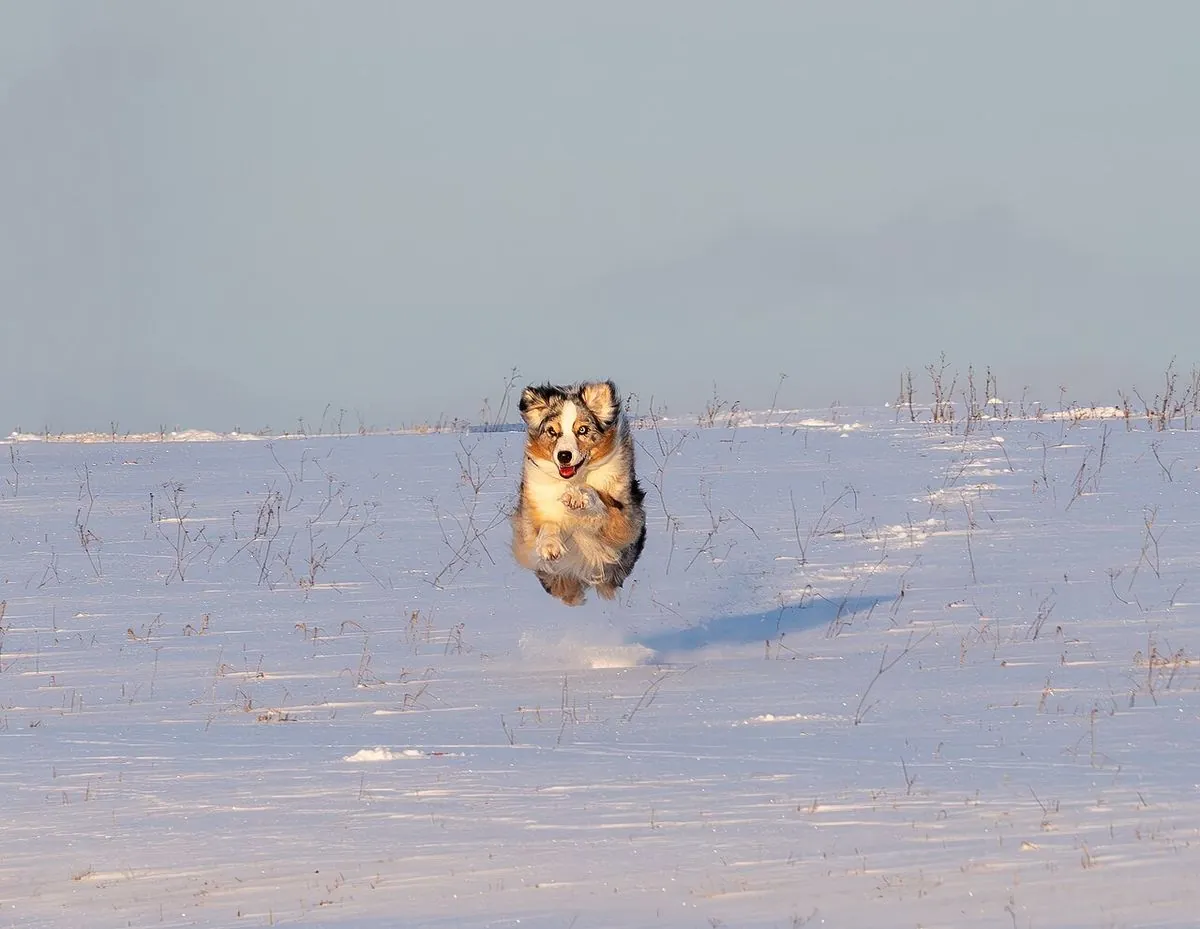
Call this one a tie. Both breeds need real daily exercise plus mental work, and both get destructive or neurotic without it. Plan on at least one to two hours of activity a day for a healthy adult of either breed, split between hard exercise and brain games.
The difference is texture. Border Collies often have a hard time switching off and may fixate on chasing or fetching until they drop. Aussies are often a little more playful and clownish and slightly easier to settle, though working-line Aussies can match any Border Collie. Our page on how much exercise a Border Collie needs breaks down what a good day looks like, and the same plan suits most Aussies.
Both breeds shine in agility, flyball, disc, obedience, rally and herding trials. Puzzle toys and tough fetch toys help on days when you can’t get out for long.
Which Breed Is Easier to Train?
Both learn fast, but Border Collies usually edge ahead. They were bred to take direction from a handler at long range, so they watch you closely and pick up cues almost instantly. The catch is that they also pick up bad habits just as fast.
Aussies are smart and eager too, but they were bred to make some decisions on their own at close range. That can read as a little more stubborn or opinionated, especially in adolescence. Their wariness of strangers also means early socialization matters a lot, so they grow into confident adults rather than nervous guarders.
For either breed, keep sessions short, use rewards and give the dog a job. Our Border Collie training guide covers the basics, and nearly all of it applies to Aussies as well.
Grooming and Shedding
Both breeds have double coats and both shed. Expect steady hair year-round and a heavy “blowout” once or twice a year when the undercoat comes out in clumps.
Aussies usually need a bit more grooming. Their longer, denser coat tangles behind the ears, on the pants and in the tail feathering. A rough-coated Border Collie needs similar care, while a smooth-coated one is the easiest of the lot. Brushing two or three times a week, and daily during blowouts, keeps either breed under control.
See Border Collie shedding and grooming for tools and a brushing routine that works for both breeds.
Health Problems: Shared and Different
Each breed has its own inherited problems, and most of the serious ones have DNA tests. Ask any breeder for both parents’ results.
Conditions Both Breeds Share
- Collie eye anomaly (CEA), an inherited eye defect caused by the same NHEJ1 gene deletion in both breeds.
- Hip dysplasia, a loose hip joint that leads to arthritis. Parents should have hip scores from OFA or PennHIP.
- Idiopathic epilepsy, which can be severe in both breeds and has no DNA test yet.
- Deafness and eye defects linked to merle, especially in double merles.
Mostly an Aussie Problem: HSF4 Cataracts and MDR1
A mutation in the HSF4 gene is the main cause of hereditary cataracts in Aussies. A 2009 study found dogs carrying it were about 17 times more likely to develop cataracts in both eyes. It’s dominant, so one copy is enough to raise the risk.
MDR1 is the bigger day-to-day difference. Dogs with this mutation can’t pump certain drugs out of the brain, so ordinary medicines like loperamide (Imodium) or high doses of ivermectin can cause tremors, blindness or worse. According to Washington State University’s MDR1 breed list, about 50% of Australian Shepherds have the mutation, compared with fewer than 5% of Border Collies.
If you own an Aussie or an Aussie mix, get an MDR1 test and tell your vet the result. Until you know, treat your dog as if it could be sensitive.
Mostly a Border Collie Problem: NCL, TNS, IGS and Collapse
Border Collies carry a few rare but serious inherited diseases. Neuronal ceroid lipofuscinosis (NCL) is a fatal brain disease, trapped neutrophil syndrome (TNS) weakens a puppy’s immune system, and Imerslund-Gräsbeck syndrome (IGS) stops puppies from absorbing vitamin B12. All three have DNA tests. Border Collie Collapse, a wobbly, confused episode after hard exercise, has no test yet.
Our full rundown of common health problems in Border Collies explains signs and screening for each one. Your vet can tell you which tests make sense for your dog.
Border Collie vs Australian Shepherd Lifespan
Both breeds live about 13 years on average, which is longer than most dogs. A 2024 UK study of more than 580,000 dogs found a median lifespan of 13.1 years for Border Collies and 13.7 years for Australian Shepherds, against 12.7 years for purebred dogs overall.
Don’t read too much into the gap. The Aussie figure is based on only 62 deaths, so it’s far less certain than the Border Collie number. The McMillan longevity study is free to read if you want the details. Weight control, exercise and good vet care matter more than breed here, and our Border Collie lifespan page covers what helps.
Which Is Better for Families, First-Time Owners and Apartments?
Neither breed is a low-effort pet, and honesty here saves a lot of rehoming. The right choice depends more on your lifestyle than on the breed.
- With families, both can be loving with kids they’re raised with, but both may nip at running children. Aussies often bond with the whole family and act as watchdogs. Border Collies often attach most strongly to one person.
- For first-time owners, both are hard first dogs. An Aussie can be a little more forgiving thanks to its playful side, but it needs more work on socialization. Read are Border Collies good first dogs before you commit to either.
- Apartment life is possible for both only if you give hours of outdoor exercise every day. Aussies may bark more at hallway noise, while Border Collies may react to movement. Our guide to Border Collies in apartments covers what it takes.
- For active owners and dog sports, either breed is a great fit. Pick a Border Collie for the most precise, handler-focused partner, or an Aussie if you want a sturdier, goofier companion with some guard instinct.
Border Collie Australian Shepherd Mix (Border Aussie)
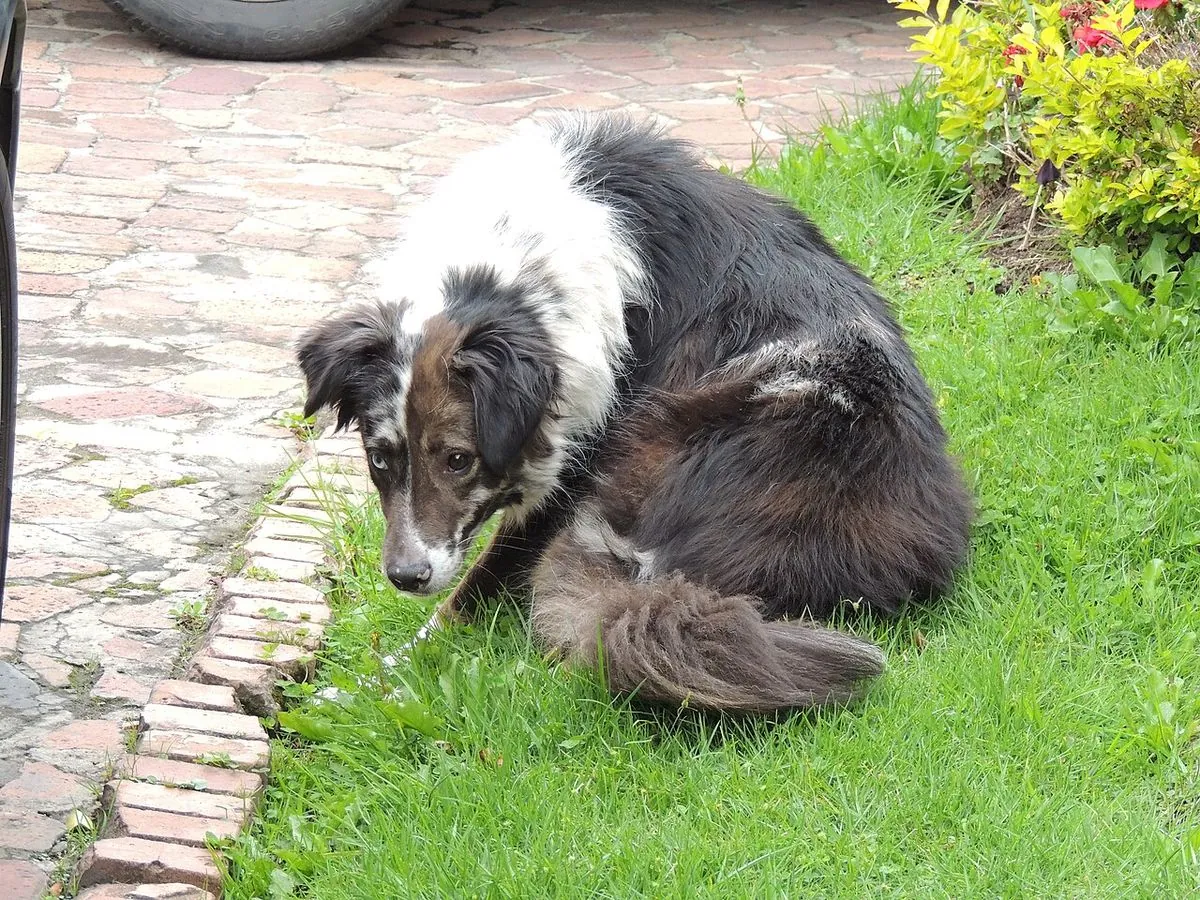
A Border Collie Australian Shepherd mix, often called a “Border Aussie,” is a cross between the two breeds. It isn’t a recognized breed, so there’s no standard, and puppies in the same litter can look and act very differently.
Expect a medium dog that lands somewhere inside the parents’ ranges, roughly 18 to 23 inches tall and about 30 to 65 pounds, depending on which parent it takes after. Coats run from smooth to fluffy, and merle is common if the Aussie parent is merle. Some mixes inherit the Aussie bobtail.
Energy is not a gamble. Two high-drive herding parents make a high-drive puppy, so plan for the same exercise and training a purebred of either breed needs. Mixes also often show up in shelters when owners underestimate that, so check Border Collie rescues by state if you’d like to adopt one.
Health-wise, a mix can inherit problems from either side. Ask for MDR1 testing, since the Aussie parent has about even odds of carrying it, plus CEA, HSF4 and hip results. A cross with a Miniature Australian Shepherd (now the Miniature American Shepherd) will usually be smaller but just as busy.
Border Collie vs Australian Shepherd FAQ
Is a Border Collie or Australian Shepherd Smarter?
Both are among the smartest breeds, and the difference is in how they use it. Border Collies are usually quicker at learning commands from a handler. Aussies are just as bright but more independent, so they may think for themselves on the job. Either one will outsmart an owner who doesn’t keep it busy.
Is an Australian Shepherd Bigger Than a Border Collie?
Usually, but only slightly. Male Aussies stand about 20 to 23 inches against 19 to 22 for male Border Collies, and Aussies often weigh more because of a sturdier frame and thicker coat. Females of both breeds overlap at about 18 to 21 inches. Working lines of both are often lighter than show lines.
Do Australian Shepherds Shed More Than Border Collies?
Aussies often seem to shed a little more because their coat is longer and denser, but rough-coated Border Collies come close. Both breeds drop hair year-round and blow their undercoat once or twice a year. Regular brushing with an undercoat rake keeps the hair off your floors far better than any change of breed.
Are Border Collies Australian?
No. Border Collies come from the border region between England and Scotland. Oddly, the Australian Shepherd isn’t Australian either. It was developed in California, and its name likely comes from collie-type dogs that arrived with sheep imported from Australia. “Australian red” is just a color name used in Border Collies.
How Can You Tell a Border Collie From an Aussie?
Look at the tail, coat and color first. A long, low tail, a lean build and black and white coloring suggest a Border Collie. A bobbed tail, a thick wavy coat and blue or red merle suggest an Aussie. Watch them work, too: a crouching, staring dog is more likely a Border Collie.
Are Border Aussies Good Family Dogs?
Border Aussies can be great family dogs for active households that train and exercise them every day. They’re affectionate and loyal, but they may herd and nip small children and can be wary of strangers. In a quiet home without a job to do, they often become anxious, noisy or destructive.