
Border Collies come in almost any color. Black and white is the look most people picture, but the breed also comes in brown (often called red), Australian red, blue, lilac, merle, sable, brindle, tricolor and mostly white. The AKC breed standard accepts every color and pattern and asks only that white not predominate.
The American Border Collie Association says the usual colors are black, black with tan, and reddish-brown, usually with white markings, and it notes that merle, brindle and mostly white dogs also turn up. Below you’ll find every color and pattern, what the registries say about them, the genetics in plain words, the health risks tied to merle and heavy white, and the different types of Border Collie.
Border Collie Colors at a Glance
Most colors below can also appear with tan points (tricolor) and with the usual white collar, blaze, legs and tail tip.
| Color | What it looks like | What causes it | Other names |
|---|---|---|---|
| Black | Black coat, black nose | At least one copy of the black gene (B) | Black and white, black and tan |
| Brown | Brown coat, brown (liver) nose and eye rims | Two copies of the brown gene (bb) | Red, chocolate, liver |
| Australian red | Red to gold coat that can be quite pale | Two copies of recessive red (ee), which hides black and brown pigment in the coat | ee red, recessive red, blonde, gold |
| Blue | Gray or slate coat | Black diluted by two copies of the dilute gene (dd) | Gray, grey |
| Lilac | Pale grayish brown | Brown diluted by dilute genes (bb dd) | Dilute chocolate |
| Blue merle | Gray coat with black patches | One copy of merle on a black dog | Merle |
| Red merle | Light brown coat with darker brown patches | Merle on a brown dog | Chocolate merle, brown merle |
| Slate merle | Muted gray coat with darker gray patches | Merle on a blue (dilute black) dog | Slate |
| Lilac merle | Pale, washed out coat with darker lilac patches | Merle on a lilac dog | None common |
| Tricolor | Any base color with tan on the eyebrows, cheeks, legs and under the tail | Two copies of the tan point gene (at), when no dominant black (KB) hides them | Black tri, red tri, blue merle tri |
| Sable | Light hairs with darker tips | The sable gene (Ay), when no dominant black (KB) hides it | Shaded sable, sable and white |
| Brindle | Dark stripes over a lighter color | The brindle gene (Kbr) | Brindle points |
| Mostly white | White body with color mainly on the head | Heavy white spotting (piebald), or double merle | White factored, white Border Collie |
What Do the Breed Standards Say About Color?
None of the big registries ranks one color above another. They differ mostly on how much white they’ll accept and how much they care about looks at all.
AKC Border Collie Colors
The AKC Border Collie standard, approved in 2015, says the breed “appears in all colors or combination of colors and/or markings” and that all colors “are to be judged equally with no one color or pattern preferred over another.”
It adds a few details. White markings may be clear or ticked to any degree. Random white patches on the body are fine as long as white doesn’t predominate. The ear color should match the main body color. Color and markings always come second to the dog’s structure and movement.
Royal Kennel Club (UK)
The UK standard is shorter. The Royal Kennel Club Border Collie standard says a “variety of colours” is permissible and “white should never predominate.” The club registers merle Border Collies, but it won’t register puppies from a merle to merle mating because of the health risks.
ISDS and ABCA: Working Registries
The working registries ignore color. The International Sheep Dog Society (ISDS) in the UK registers puppies from registered parents. An unregistered adult can join the stud book on merit, by placing at open sheepdog trials or passing a test of outrun, lift, fetch and driving. Color isn’t part of either route.
The American Border Collie Association (ABCA) takes the same line. Its advice on choosing a Border Collie says that “appearance is not linked with working characteristics,” so you should pick a puppy whose looks you like. The parents are your best guide to what the pups will be like.
How Border Collie Color Genetics Work
Every Border Collie starts with one of two base pigments: black or brown. Other genes then dilute that pigment, hide it, break it into patches, or add tan, stripes and white. Once you know which gene does what, the long list of color names makes sense.
Most of what follows comes from the Border Collie Club of South Australia’s coat color guide, which explains each gene in breed terms.
Black and White Border Collie
Black is dominant, so a puppy needs only one copy of the black gene (B) to be black. A black dog can still carry one hidden copy of brown (Bb) and pass it on. That’s why two black and white parents sometimes have a brown puppy. Only a DNA test tells you for sure whether a black dog carries brown.
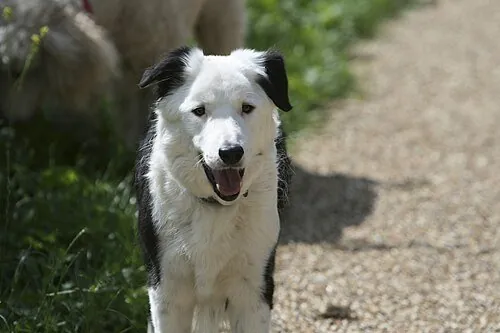
A black Border Collie with no white at all is possible too. Solid color comes from a version of the white spotting gene that produces no white.
Brown, Red and Chocolate Border Collies
A brown Border Collie has two copies of the recessive brown gene (bb), which turns all black pigment brown. You can spot one by the nose: brown dogs have liver-colored noses, eye rims and lips instead of black.
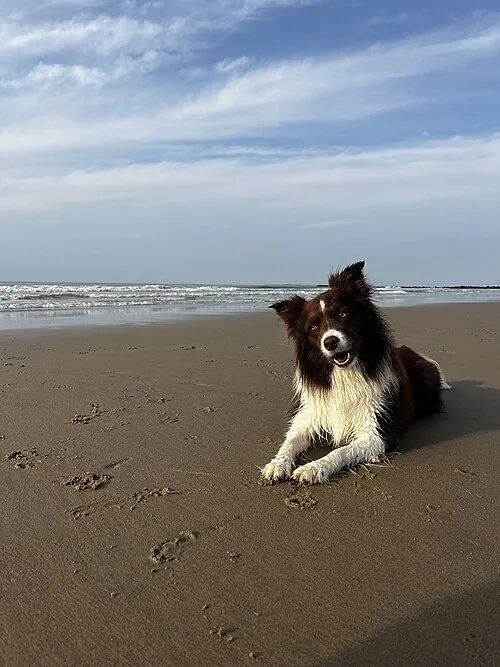
In many countries this is the dog called a red Border Collie. Australians call the same color chocolate. Brown and white, red and white, and chocolate Border Collies are all usually the same bb dog.
Australian Red, Blonde and Gold Border Collies
Australian red is a different red caused by a different gene. A dog with two copies of recessive red (ee) can’t make black or brown pigment in its coat, so the coat shows as red, gold or cream. Outside Australia this color is called Australian red or ee red, and Australians just call it red. Blonde, champagne, cream, honey, golden and wheaten are all names for shades of the same ee red.
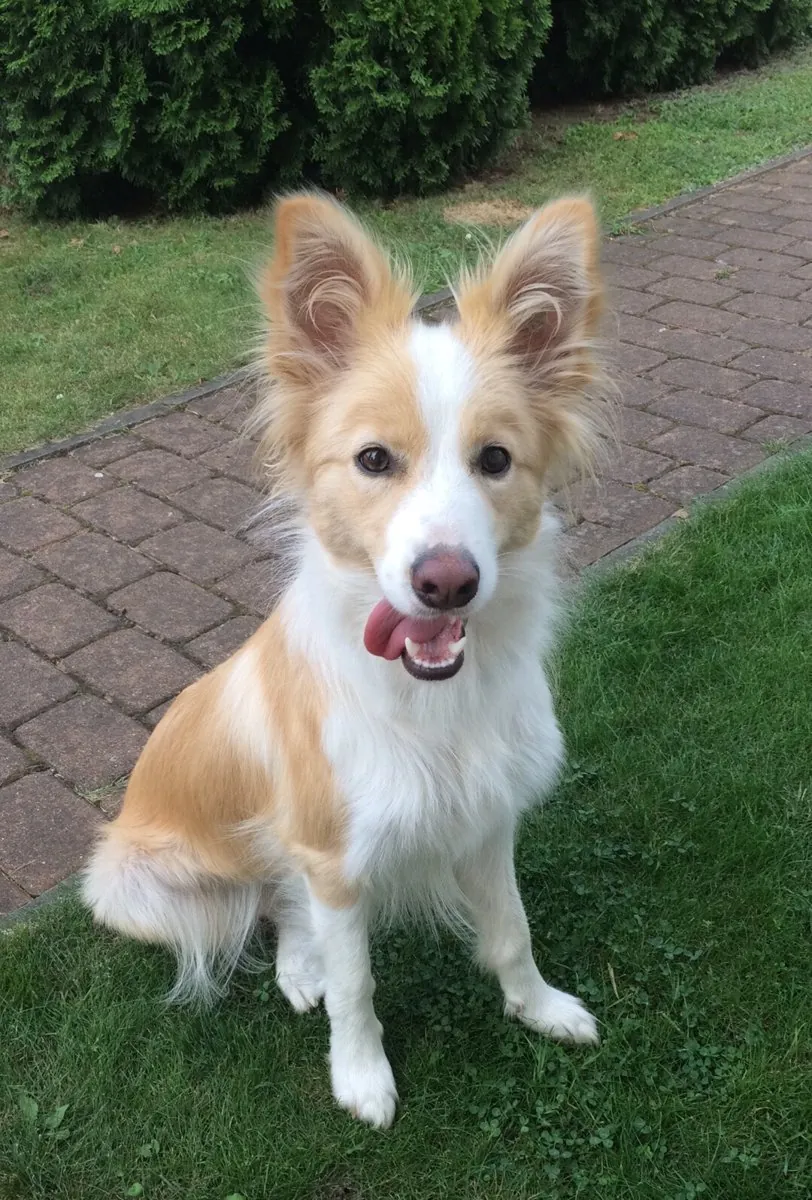
The ee gene hides what’s underneath. An ee red dog can secretly carry merle, sable or tan points and you can’t see it. Breeders who pair an ee red with a merle risk breeding two merles together without knowing it, so a DNA test matters here.
Blue, Gray and Lilac Border Collies
These are the dilute colors. A dog with two copies of the dilute gene (dd) has its pigment lightened:
- Blue is diluted black. These are the dogs people call gray or grey Border Collies.
- Lilac is diluted brown. The dog needs two brown genes and two dilute genes (bb dd), so both parents must carry both.
Merle: Blue Merle, Red Merle, Lilac Merle and Slate Merle
Merle is a pattern, not a color. The merle gene (M) is dominant, so one copy is enough. It lightens the base color in random patches and leaves irregular spots of full color behind. What the merle looks like depends on the color underneath:
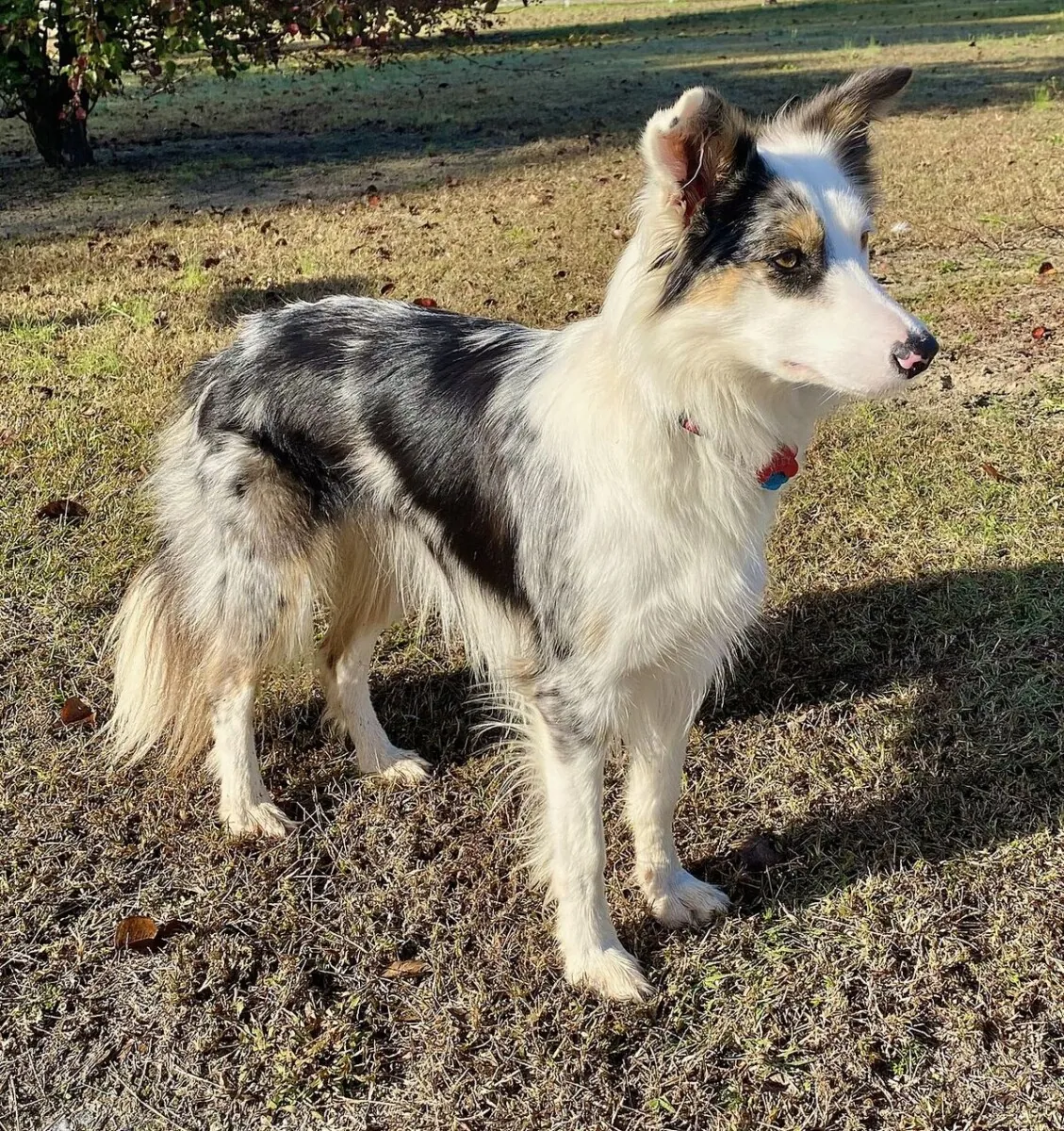
- Blue merle: merle on a black dog, giving a gray coat with black patches.
- Red merle: merle on a brown dog.
- Slate merle: merle on a blue dog. A blue merle is not a merle on a blue dog, a common mix-up.
- Lilac merle: merle on a lilac dog.
Merle comes in several strengths. Some versions are so weak (cryptic merle) that the dog looks solid but still carries merle. Others are so strong that the coat turns mostly white. Merle Border Collies are easy to confuse with Australian Shepherds, and our Border Collie vs Australian Shepherd comparison covers how to tell the two breeds apart.
Tricolor Border Collies and Tan Points
A tricolor Border Collie has tan points: patches of tan over the eyes, on the cheeks, on the legs and under the tail. It takes two copies of the recessive tan point gene (at). The base color decides the name, so you’ll see black tri, red tri (brown with tan) and blue merle tri (merle with tan).
Black and tan, and black, white and brown Border Collies are usually tricolors with more or less white. Some dogs show only faint tan points, which breeders call ghost tri.
Sable and Sable Merle Border Collies
Sable dogs have hairs that are light at the base and darker at the tip, so the coat looks shaded. Sable is dominant over tan points. But a separate gene decides whether either pattern can show: a dog with even one copy of its dominant black version (KB) comes out solid colored, whatever it carries for sable or tan. A dog with one sable and one tan point gene is often a shaded sable.
Merle may not show at all on a clear sable coat, so a sable merle can pass as a plain sable. That’s the same hidden merle risk as with ee reds.
Brindle Border Collies
Brindle adds dark stripes over the lighter parts of the coat. On a sable it makes a fully striped dog, and on a tricolor it turns the tan points striped (brindle points). The brindle gene doesn’t show up often in Border Collies, and the ABCA lists it separately from the typical colors, along with merle and mostly white.
White Markings, Ticking and White Border Collies
The classic white blaze, collar, chest, legs and tail tip is called Irish spotting. Nobody has yet proven which gene variant causes it. Dogs with two copies of the piebald gene (sp) carry more white, often keeping color only on the head, at the base of the tail and in a few body patches. These are called white factored.
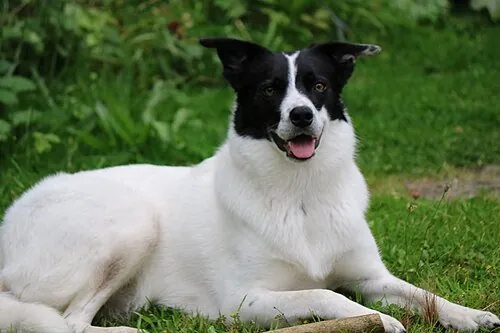
Ticking is the small flecks of color on white areas, usually the muzzle and legs. It isn’t there at birth and fills in as the puppy grows, so a clean white puppy can become a freckled adult. Ticking shows up more often in working lines and isn’t a fault in the show ring.
An all white Border Collie is usually an extreme white piebald with a little color left on the head, sometimes with a pink nose and blue eyes. A mostly white dog can also be a double merle. The South Australian breed club says extreme white should be avoided and warns that pairing heavy white with merle raises the chance of hearing and sight problems. Both the AKC and UK standards say white shouldn’t predominate.
What Is a Double Merle Border Collie?
A double merle is a puppy with two copies of the merle gene, one from each parent. When two merles are bred together, on average one puppy in four will be a double merle. These dogs are often mostly white, with very little color and abnormally small eyes.
Double merles have a much higher risk of deafness and eye problems, including blindness. A 2009 hearing study of 153 merle dogs of several breeds in the Journal of Veterinary Internal Medicine found:
| Dog | Deaf in one ear | Deaf in both ears |
|---|---|---|
| Single merle (one copy) | 2.7% | 0.9% |
| Double merle (two copies) | 10% | 15% |
That’s 25% of double merles with some deafness, against about 3.6% of single merles. For this reason the Royal Kennel Club will not register puppies from merle to merle matings. If you’re buying a merle puppy, ask whether both parents were merle, and steer clear if they were.
Does Color Affect a Border Collie’s Health or Temperament?
For most colors, there’s no known health link. The exception is hearing and sight in dogs with merle, blue eyes or a lot of white on the head.
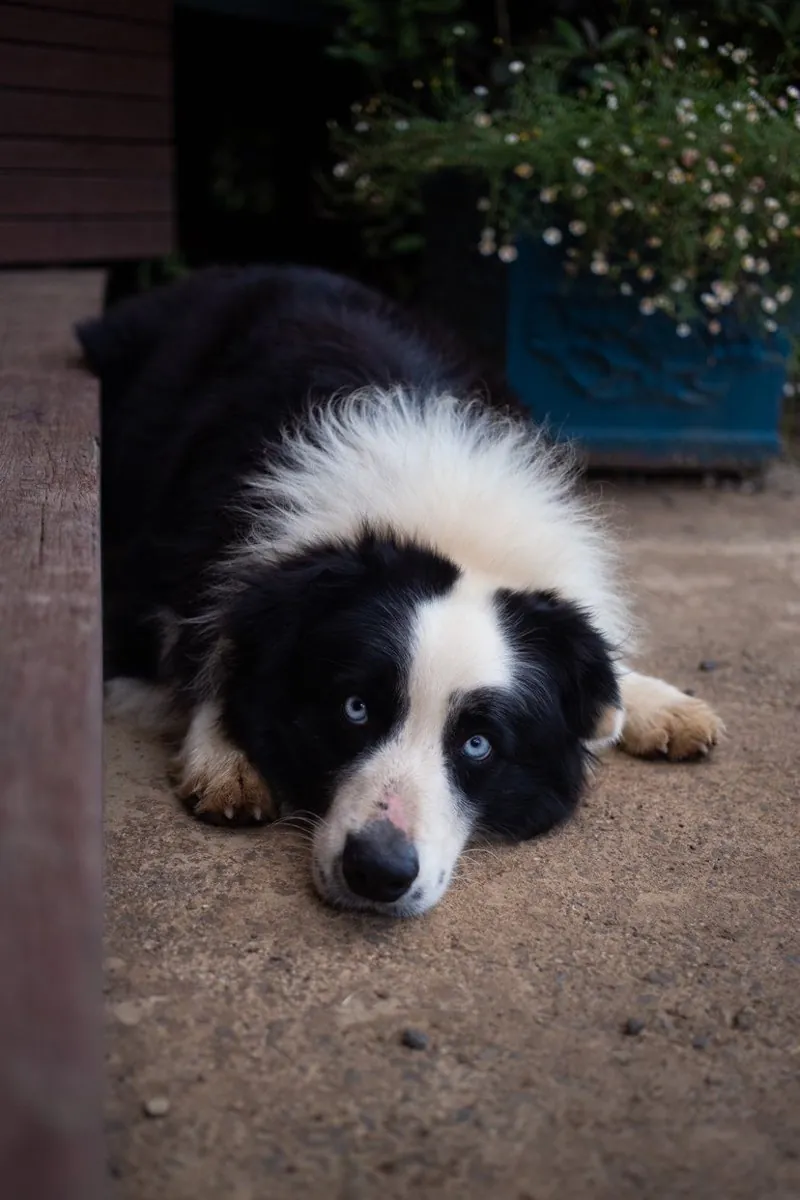
A UK study of 2,597 BAER hearing tested Border Collies found that 2.8% of puppies were born deaf in one or both ears. The deaf dogs had higher rates of merle coats, blue eyes and excess white on the head than dogs with normal hearing, and puppies of deaf mothers had 14 times the odds of being deaf themselves (Platt and colleagues, 2006). If your puppy is merle, blue eyed or white headed, a BAER hearing test is worth asking your vet about. The Border Collie health problems guide covers deafness and the breed’s other DNA tests.
As for personality, the ABCA says appearance isn’t linked with working traits. Coat color won’t tell you how driven a dog will be. The breeding behind it tells you far more. The Border Collie temperament guide explains what does shape their personality.
Border Collie Eye Colors: Can They Have Blue Eyes?
Yes. Most Border Collies have brown eyes, but a merle can have one blue eye, two blue eyes, or an eye that is only partly blue.
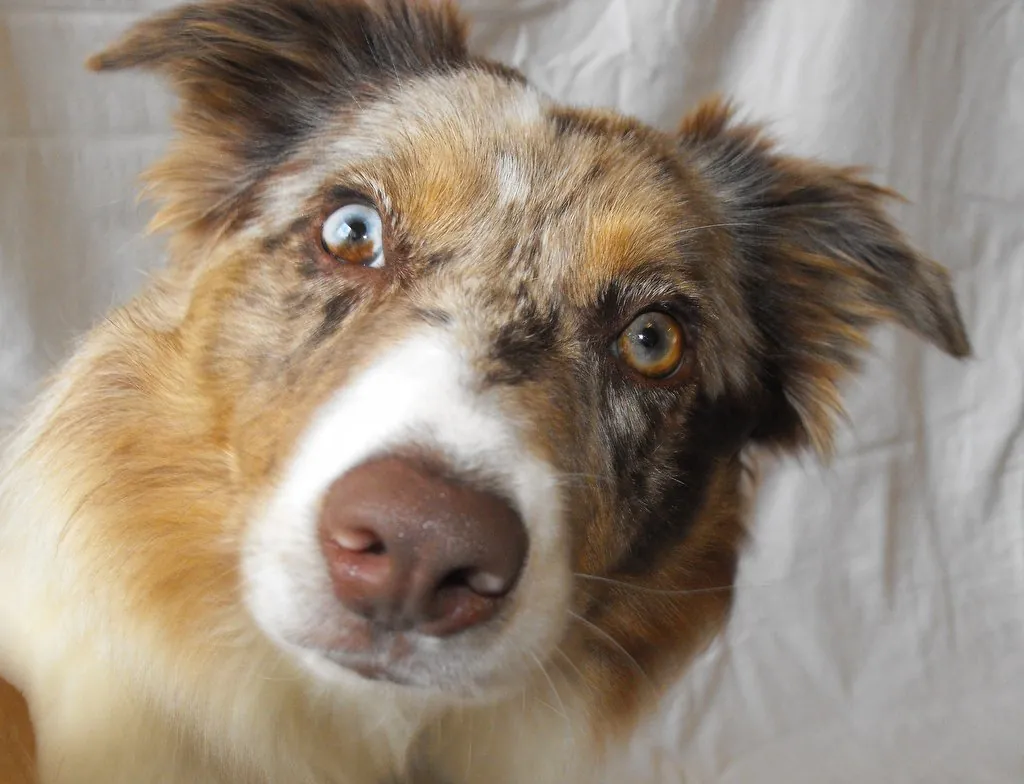
The two main standards treat eye color a little differently. The AKC accepts any eye color but says blue eyes in dogs that aren’t merle are “not preferred.” The UK standard asks for brown eyes except in merles, where one or both eyes, or part of an eye, may be blue. Mostly white dogs can have blue eyes too.
In the UK hearing study, blue eyes were more common among deaf Border Collies, so a blue eyed puppy is a good one to hearing test.
Are Some Border Collie Colors Rare?
There are no published registry counts of Border Collies by color, so nobody can give an honest rarity ranking. What breed groups do say is general. The ABCA calls black, black with tan, and reddish-brown the typical colors. The South Australian breed club says brindle doesn’t pop up often, and a lilac puppy has to inherit both the brown and the dilute gene from each parent.
The same club warns that colors are generally no longer rare and buyers should beware of excessive prices, since every puppy costs the same to raise whatever its color. A breeder charging extra for blue merle or lilac is pricing the coat, not the dog.
Types of Border Collies
There is only one Border Collie breed. When people talk about types, they usually mean coat type, working versus show breeding, or the four old bloodline types described below.
Rough, Medium and Smooth Coat Border Collies
The AKC standard allows two coat varieties, rough and smooth, and says “neither coat type is preferred over the other.” The UK standard calls them moderately long and smooth. The ABCA describes coats as smooth, medium or rough, since working dogs fall anywhere in between.
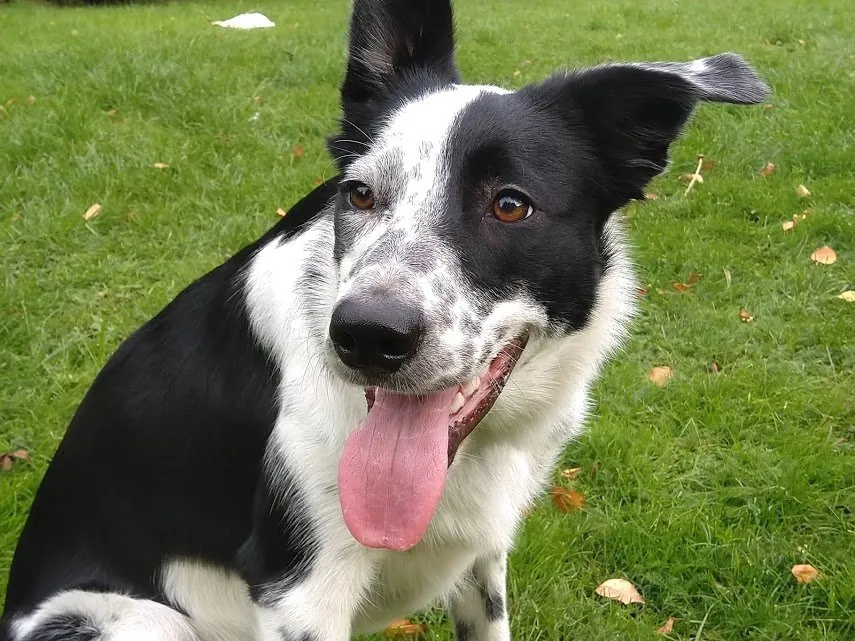
- Rough coat: longer hair with feathering on the forelegs, haunches, chest and underside. The UK standard says the longer coat forms a mane, and the AKC says proper texture matters more than length.
- Smooth coat (short haired): short hair over the whole body, usually coarser than the rough coat, with only slight feathering.
- Medium coat: a looser working term for dogs between the two.
Both are double coats. Long hair in dogs has been linked to a variant of the FGF5 gene, according to NIH research on dog coat genes. Smooth coats aren’t low shedding, and the Border Collie shedding guide covers grooming for each coat.
Border Collie Ears: Prick, Semi-Erect and Tipped
Border Collie ears can stand straight up, stand partway with the tips folded over, or sometimes hang down. All of these are normal, and plenty of dogs carry one ear differently from the other.
The AKC standard describes ears of medium size, set well apart, with “one or both carried erect and/or semi-erect (varying from one-quarter to three-quarters of the ear erect).” It adds that on a semi-erect ear “the tips may fall forward or outward to the side,” and that the ears are “sensitive and mobile.” The Royal Kennel Club standard is shorter: medium size and texture, set well apart, “carried erect or semi-erect and sensitive in use.”
| Ear type | What it looks like | What the standards say |
|---|---|---|
| Prick (erect) | The whole ear stands upright | Allowed by the AKC and the Royal Kennel Club |
| Semi-erect (tipped) | The base stands and the tip folds forward or out to the side | Allowed by both; the AKC says one-quarter to three-quarters of the ear stands |
| Mixed | One ear up, one ear tipped | The AKC wording “one or both” covers it |
| Drop | The ear hangs down | Not described in either standard, but it does turn up in the breed |
Border Collie ears are known for varying from dog to dog, with some fully erect, some fully dropped and many in between, as the Wikipedia breed entry notes. Ear set is a show ring detail. The working registries covered above don’t judge ears any more than they judge color, so a drop eared farm dog is every bit as much a Border Collie as a prick eared show dog.
Working Line vs Show Line Border Collies
Working line dogs are bred for herding and registered with the ISDS or ABCA on parentage and ability. Because they aren’t bred for looks, the ABCA notes that they don’t all look alike, ranging from 25 to 55 pounds with any coat.
Show line dogs are bred to match the written AKC or UK standard and are judged on structure and movement in the ring. These are breeding goals, not separate breeds, and the two often look different side by side.
What Are the 4 Types of Border Collies?
There is no official list of four types. The best-known version comes from Sheila Grew’s book Key Dogs from the Border Collie Family, which grouped Border Collies into four bloodline types named after famous dogs:
- Northumbrian type, after Old Hemp: medium sized, rough coated, with little white.
- Wiston Cap type: rough coated, larger, with a big, blocky head and more white on the collar, chest and legs.
- Nap type, after Whitehope Nap: the only smooth coated type, with a squarer, more athletic build.
- Herdman’s Tommy type, after a grandson of Old Hemp: Tommy was a rough coated black and white dog with tan markings.
These types say more about family trees than about anything you’d see in a puppy today. You can read more about Old Hemp and the breed’s founding dogs in our Border Collie history.
Rough Collies and Smooth Collies Are Separate Breeds
Searches for “types of collie” often mix in other breeds. The Rough Collie and Smooth Collie are separate breeds from the Border Collie, with their own standards and only three recognized colors in the UK: sable and white, tricolor and blue merle. A smooth coat Border Collie is still a Border Collie.
Border Collie Colors FAQ
What color is a brown Border Collie?
A brown Border Collie is genetically “bb,” meaning it has two copies of the brown gene, which turns black pigment brown. Outside Australia it’s often called red, and in Australia chocolate. You can tell it from a black dog by its brown nose. A gold or cream dog is more likely an Australian (ee) red.
Can two black and white Border Collies have a red puppy?
Yes. Brown and ee red are both recessive, so two black and white parents that each carry a hidden copy can have a red puppy. Only a DNA test of the parents shows whether they carry it.
Do Border Collie puppies change color?
The base color stays the same, but the white parts can change. Ticking isn’t visible at birth and develops as the puppy grows, so freckles can fill in on the muzzle and legs over the first months.
Does the AKC accept merle and lilac Border Collies?
Yes. The AKC standard accepts all colors and combinations of colors, judged equally. Its main color guidance is that white shouldn’t predominate and the ears should match the main body color.
Is a white Border Collie deaf?
Not always, but mostly white dogs and dogs with a lot of white on the head have a higher risk of deafness. A BAER hearing test, done by a vet, is the only way to know whether a puppy hears in both ears.
What should I name a Border Collie based on its color?
Color is an easy place to start. Our list of Border Collie names has a section of ideas by coat color, from black and white to red, merle and blue.