Border Collie herding means gathering livestock, usually sheep, with a wide circling run, then moving them with a crouching, stalking walk and a hard stare called “eye.” The dog takes directions from a handler by voice or whistle, often from hundreds of yards away, and much of the job comes from instinct the breed was selected for over generations.
How Do Border Collies Herd Sheep?
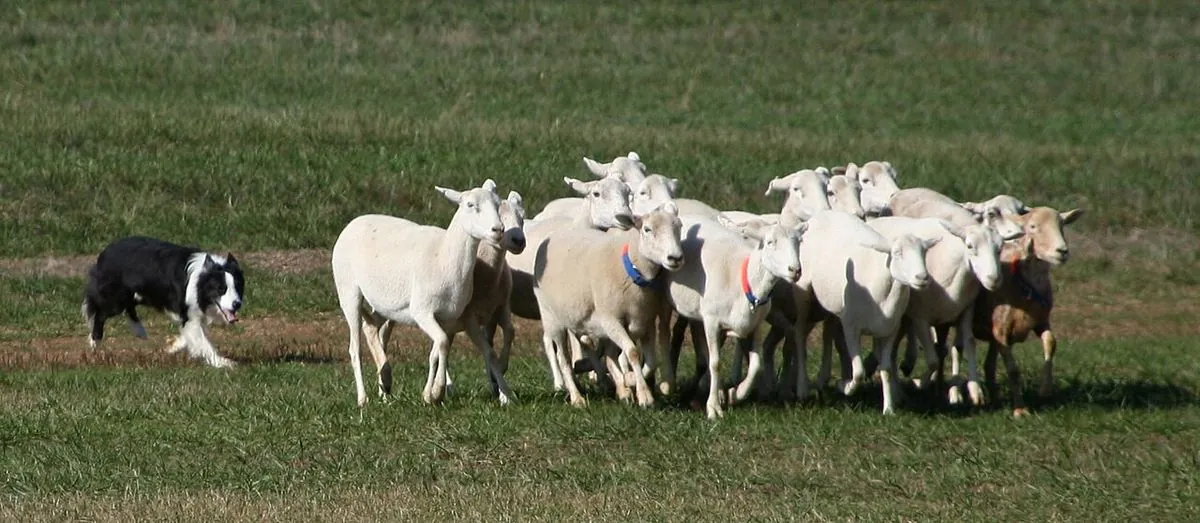
A Border Collie herds by heading the sheep. It runs out wide around the flock, stops behind them, and brings them back to the shepherd. Then it steers them wherever the shepherd wants them to go.
The AKC breed standard sums up the style: the Border Collie gathers and fetches stock “with wide sweeping outruns,” then controls it “with an intense gaze known as ‘eye’, coupled with a stalking style of movement.” The same standard calls the breed the world’s premier sheep herding dog and names one of its greatest assets: it can work out of sight of its handler without commands.
Everything a good herding dog does comes back to balance. Sheep move away from pressure, so the dog places itself on the far side of the flock from where the sheep should go. The International Sheep Dog Society (ISDS) trial rules call this spot the point of balance: the place where the dog can lift the sheep straight toward the next target.
Herding dogs are often split into two working types. Fetching or “heading” dogs go to the front of the stock to turn and stop it. Driving or “heeling” dogs work from behind and push. Border Collies are heading dogs first, though a trained one drives too, and every sheepdog trial tests both skills.
What Is “Eye” in a Border Collie?
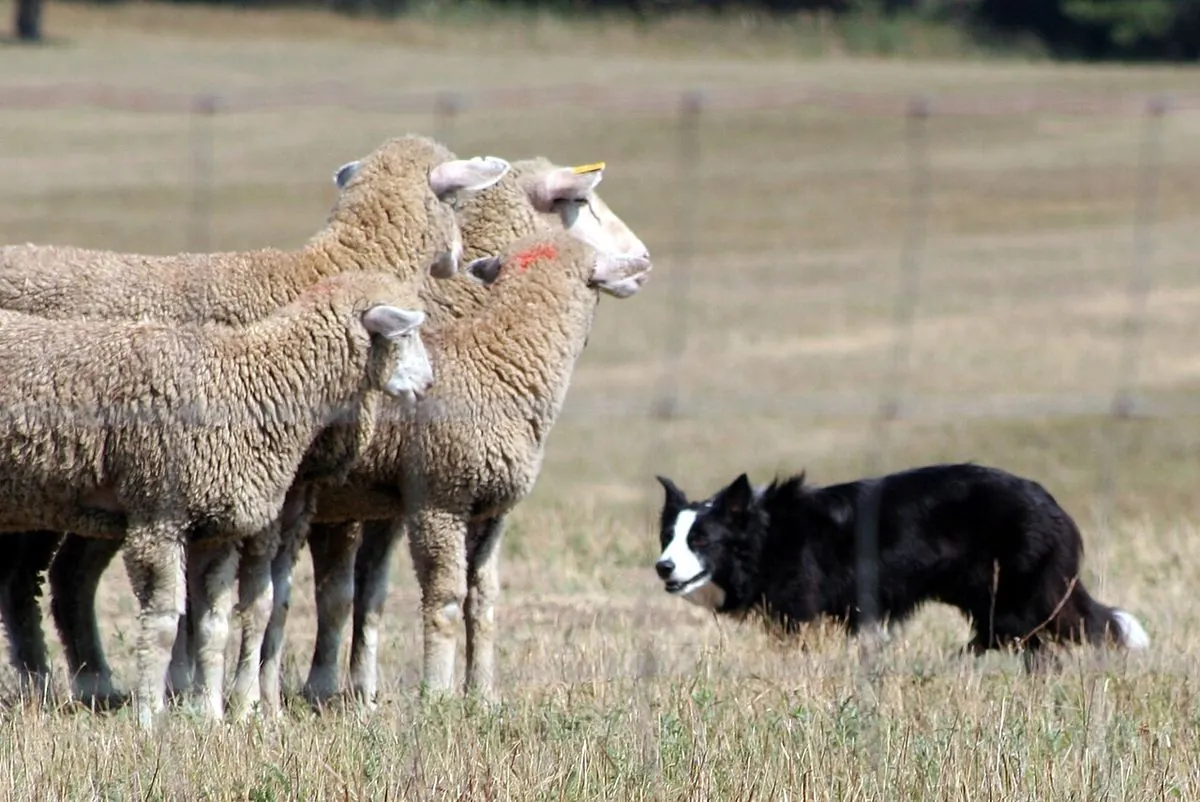
“Eye” is the fixed, intense stare a Border Collie uses to control livestock. The dog lowers its head, locks onto the sheep and holds them with its gaze. Handlers call the Border Collie a “strong-eyed” breed. Dogs like the Australian Shepherd are described as moderate or loose-eyed, and they tend to work more independently.
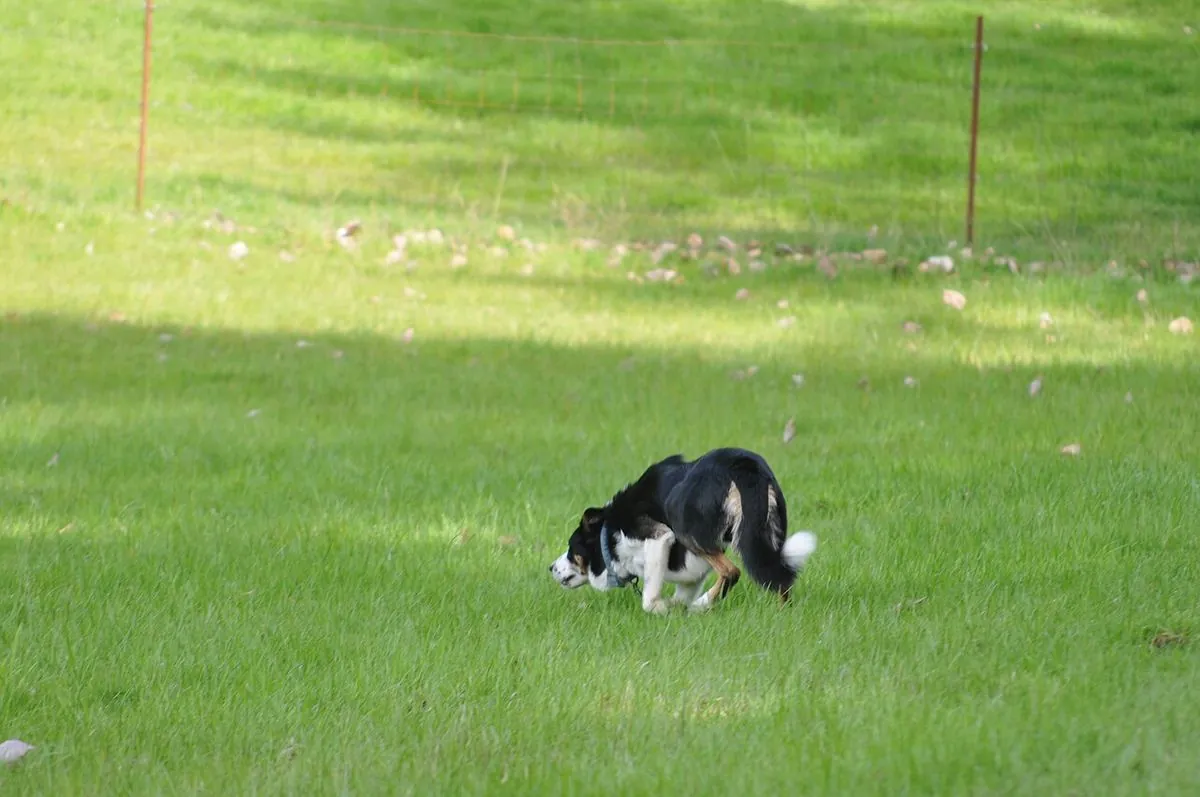
Eye grows out of the hunting instinct. A 2025 genetics study in Science Advances says Border Collies were selected to specialize in the “orient, eye-stalk, chase, and grab-bite” motor patterns during herding. That is part of the predatory sequence, and training turns it into useful work.
That same study, by Hankyeol Jeong and colleagues, compared the DNA of 50 working-line Border Collies with 9 show-line dogs. It found a version of a gene called EPHB1 that separates working lines from show lines. Dogs carrying the working-line version were more likely to show strong toy-directed chasing and grabbing on an owner survey. You can read the full herding genetics study for free.
Why Do Border Collies Crouch and Stare?
Border Collies crouch and stare because that is the stalk in their herding instinct. The AKC standard describes the breed’s shoulders as built “to allow for the characteristic crouch when approaching and moving stock.” The low posture lets the dog creep toward sheep without rushing them, and the stare keeps them steady.
Pet Border Collies do the same thing to balls, other dogs, cats and moving cars. It’s normal breed behavior, not a sign that something is wrong. Other herding breeds work differently. You can compare the Border Collie and Rough Collie herding styles, and the Border Collie vs Australian Shepherd comparison covers strong eye against loose eye.
Outrun, Lift, Fetch, Drive, Shed and Pen: The Parts of a Herding Run
A herding run breaks into phases, and an ISDS trial scores seven of them. The names come from ordinary farm work: go and get the sheep, bring them in, move them somewhere, sort some out, and shut them in a pen.
| Phase | What the dog does | ISDS points |
|---|---|---|
| Outrun | Leaves the handler and runs a wide, pear-shaped arc out to the far side of the sheep without disturbing them | 20 |
| Lift | Approaches the sheep calmly and starts them moving in a straight line | 10 |
| Fetch | Brings the sheep straight to the handler, through a set of gates on the way | 20 |
| Drive | Pushes the sheep away from the handler around a triangle through two more sets of gates | 30 |
| Shed | Splits two unmarked sheep away from the group and holds them apart | 10 |
| Pen | Puts the whole group into a small pen while the handler holds the gate rope | 10 |
| Single | Cuts one marked sheep off from the rest and keeps it away | 10 |
The total in an ISDS singles trial is 110 points. Judges start from full marks and take points off for mistakes, so the best run loses the fewest.
What Makes a Good Outrun?
A good outrun is wide enough not to spook the sheep and needs no commands after the dog is sent. The ISDS rules describe the ideal shape as one side of a pear, with the blunt end near the sheep. The dog should not cut in, should not stop early, and should finish far enough back to leave the sheep calm. A crossed outrun costs at least 80% of the outrun points.
What Is Shedding?
Shedding is separating some sheep from the rest. The handler lines the flock up and opens a gap, and the dog comes through it to split off the right animals. The rules are clear that the dog, not the handler, should make the cut. The ISDS rules describe gathering, driving, shedding, penning and singling as tasks a shepherd may need on the daily round.
What Are the Border Collie Herding Commands?
The standard herding commands tell the dog which way to circle, when to stop, when to move in, and when the work is done. “Come bye” sends the dog clockwise around the sheep and “away to me” sends it counterclockwise. Handlers vary in the exact words, but these are the common ones:
| Command | What it means |
|---|---|
| Come bye (or “bye”) | Circle the stock clockwise |
| Away to me (or “away”) | Circle the stock counterclockwise |
| Lie down | Stop, while staying in contact with the stock |
| Stand | Stop on your feet; said gently, it can mean slow down |
| Walk up | Move straight in toward the stock |
| Steady (or “take time”) | Slow down |
| Get out (or “get back”) | Move farther away from the stock |
| Look back | Go back for an animal you missed |
| That’ll do | Stop working and come back to the handler |
An easy way to remember the two directions: “away” and “anticlockwise” both start with A, and “come bye” and “clockwise” both start with C.
Handlers can give commands by voice, hand signal or whistle. Each dog usually learns its own set of whistles, so a handler can work several dogs at once without mixing them up. The ISDS rules treat a whistle exactly like a spoken command when judges count commands.
How Do Sheepdog Trials Work?
A sheepdog trial is a timed test of farm work on an open field. The handler stands at a post while the dog gathers a small group of sheep it has never seen, brings them in, drives them through gates, and finishes with a shed and a pen. In the US there are two main routes: open-field trials sanctioned by the USBCHA, and the AKC herding program, which starts with tests in fenced arenas.
Trials began as tests among shepherds. The first recorded ones were held at Bala, North Wales, in 1873, and the ISDS was founded in 1906. Our Border Collie history guide tells that story, including the trial dogs that shaped the breed.
ISDS Trials and the International Sheepdog Championship
The International Sheep Dog Society runs the National trials in England, Ireland, Scotland and Wales, and the International every September. It also keeps the ISDS Stud Book and registers more than 6,000 Border Collie pups a year for its members.
Under the 2023 ISDS rules, a National or International qualifying run looks like this:
- Five sheep, three plain and two marked with collars
- A gather of 400 yards from the handler
- Fetch gates 7 yards wide, 150 yards out from the handler
- A 450-yard triangular drive through two more 7-yard gates
- A shedding ring 40 yards across and a pen 9 feet by 8 feet
- A 15-minute time limit with no extension
The top prize is the Supreme Championship, open to the 15 highest-scoring dogs from the International qualifying rounds. It is a “double lift.” The dog fetches one packet of 10 sheep from about 800 yards away, then is sent for a second packet of 10 it may not have seen. It drives all 20 on a 600-yard triangle, sheds off 15 unmarked sheep to leave the 5 collared ones, and pens those 5, all within 30 minutes. The run is worth 170 points.
USBCHA and ABCA Trials in North America
In the US and Canada, open-field sheepdog trials are often sanctioned by the United States Border Collie Handlers’ Association (USBCHA). Its Open trials are open to all dogs regardless of breed or registration. A USBCHA National-style course scores the outrun (20), lift (10), fetch (20), drive (30), pen (10) and shed or single (10) for 100 points.
Young dogs run in the Nursery class. Under USBCHA rules, a dog is eligible for the Nursery Finals if its third birthday falls on or after July 1 of the Finals year. Nursery dogs run a full National-style course without the shed. The season builds to the National Sheepdog Finals, and there are separate Cattledog Finals for dogs that work cattle.
The American Border Collie Association (ABCA) is the registry side of this world. It registers working Border Collies and promotes stockdog trials, and handlers must be ABCA members to run at the USBCHA National Finals. Its Register on Merit program lets a dog whose ancestry isn’t fully known into the stud book. One route is a live evaluation, where the dog must show “outstanding abilities in outrun, lift, fetch, driving” plus good balance, power and eye.
AKC Herding Tests and Trials
The AKC herding program is the easiest place for a pet owner to start, because it begins with simple pass or fail tests in a fenced arena. According to the AKC Herding Regulations (amended August 2025), the levels are:
| AKC level | What the dog must show | Earned |
|---|---|---|
| Instinct Test | Sustained interest in herding stock, by circling, gathering or driving. Starts on a 6 to 15 foot long line with a stop and a recall | Instinct Tested certificate after passes under two different judges |
| Herding Tested (HT) | Controlled moves between two markers with two turns, a pause at the start, and a stop and recall at the end, within 10 minutes | HT title after two passes under two judges |
| Pre-Trial Tested (PT) | A simple course around the arena, just below beginning trial level | PT title after two passes under two judges |
| Trials: Started, Intermediate, Advanced | Scored runs on Courses A to D | Herding titles, and Herding Champion at 15 points in Advanced |
Dogs can enter an Instinct Test from six months old and other tests and trials from nine months. Spayed and neutered dogs can take part. The four trial courses each copy a different kind of farm work. Course A is an all-around farm course set in an arena with obstacles. Course B is an open-field trial with an outrun and drive. Course C copies a tending shepherd grazing a flock between unfenced areas, and Course D copies everyday ranch and stockyard work.
Can a Pet Border Collie Learn to Herd?
Yes, many pet Border Collies can learn to herd. How far a dog goes depends on its breeding, its temperament and the training it gets. Being a pet doesn’t rule a dog out.
Breeding matters. Dogs from working lines were chosen for their stock sense, while show lines were chosen mainly for looks, and the 2025 EPHB1 study found real genetic differences between the two. Still, breeding only tells you the odds. The only way to know about your own dog is to put it in front of stock with an experienced trainer.
Instinct alone isn’t enough, though. The AKC regulations say dogs “must have training and prior exposure to livestock” before entering any test or trial. Dogs that chase or harass stock don’t pass. A dog that already has a solid stop and a reliable recall is far easier and safer to start, and our Border Collie training guide covers how to build both at home.
How to Get Started With Herding Lessons
Start by finding a stockdog trainer who keeps dog-broke sheep, the calm stock used for teaching dogs. Herding can’t be learned from videos alone, because a green dog needs safe livestock and a person who can read both the dog and the sheep. These steps are a sensible way in:
- Teach a stop and a recall first. “Down” and “come” that work around distractions are what keep sheep safe on day one.
- Go and watch a trial. The USBCHA posts upcoming sheepdog trials on its website, and the ISDS lists UK trials. Handlers there can often point you to local trainers.
- Find a trainer near you. Ask your local herding or stockdog club, and ask to watch the trainer’s own dogs work before you book.
- Try an instinct test or an evaluation. An AKC Instinct Test or a first lesson shows whether your dog has real interest in stock.
- Keep lessons regular. The handler has as much to learn as the dog.
Ask a trainer which program they teach for. Some train dogs for USBCHA open-field trials, some for AKC arena work, and some for farm use only. Each path teaches the same core skills, but the goals and the stock differ.
Can Border Collies Herd Ducks and Cattle?
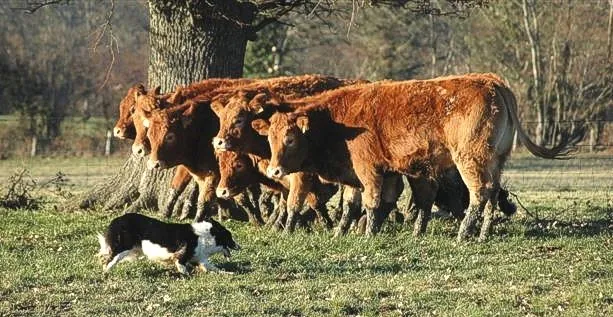
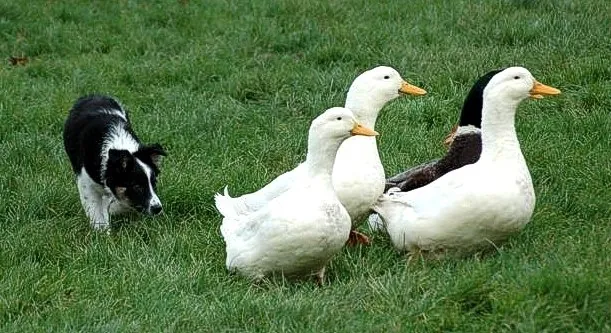
Yes. Border Collies are bred mainly for sheep, but they also work ducks and cattle. The AKC herding program uses all three. Its Course A arenas for ducks run about 50 by 100 feet up to 100 by 200 feet, and trial cattle should weigh at least 450 pounds.
Cattle work has its own competitions too. The USBCHA runs a separate cattledog trial circuit, with Open and Nursery Cattledog Finals for dogs that work cattle.
Herding Behavior at Home: Chasing Cars, Nipping and Herding Kids
A Border Collie with no sheep will find something else to herd. Kids, cats, bikes, joggers and cars all trigger the same eye, stalk and chase sequence a sheepdog uses on a hill. Some dogs add a nip at the heels, which is how a herding dog turns an animal that won’t move.
Staring at a ball is harmless. Chasing cars and nipping children are not, and both need managing early. Our guide to Border Collie temperament shows how the herding instinct looks at home, with tips for families with young kids.
The fix is to give the instinct a safe place to go. Good outlets include:
- Real herding lessons, even once a week, if there’s a trainer within reach
- Large herding balls the dog can push and steer, like the ones in our Border Collie herding toys guide
- Fetch and flirt-pole games with rules: wait, go, drop, and “that’ll do” to end the game
- Enough daily running and brain work, set out in our guide to how much exercise a Border Collie needs
- A leash or long line near roads until you’re sure your dog will ignore moving cars
Borrowing herding words at home helps too. A dog that learns “lie down” and “that’ll do” in play already knows two of the most useful commands if you ever try sheep.
Border Collie Herding FAQ
At what age can a Border Collie start herding?
There’s no single answer, but the rulebooks give a guide. The AKC lets dogs enter an Instinct Test at six months and other herding tests and trials at nine months. In USBCHA trials, dogs compete as Nursery dogs until about three years old. Ask your trainer when your own dog is ready.
What does “that’ll do” mean to a sheepdog?
“That’ll do” tells the dog the work is finished: stop herding and come back to the handler. It’s usually the last command in a run or a lesson. Many pet owners use it the same way to end a game of fetch or to call the dog off something it’s fixed on.
Are Border Collies the best herding dogs?
For gathering sheep over open ground, they’re the benchmark. The AKC breed standard calls the Border Collie the world’s premier sheep herding dog, a job it still does worldwide. Other herding breeds have different styles that suit other jobs, such as heeling dogs that push stock from behind.
Can other breeds compete in sheepdog trials?
Yes. USBCHA Open trials are open to all dogs regardless of breed or registration status. AKC herding events are limited to breeds accepted into its herding program, and the Border Collie is one of them.
Do Border Collies bite sheep?
A well-trained Border Collie moves sheep with eye and position, not its teeth. The grab-bite is part of the instinct, so training aims for calm control. AKC tests fail dogs that chase or harass stock, and ISDS judges mark down a dog that rushes in and startles the sheep.
How far can a Border Collie work from its handler?
A long way. A standard ISDS trial sets the sheep 400 yards from the handler, and in the Supreme Championship each packet of sheep is about 800 yards away. At those distances the dog must make its own decisions, which is why the AKC standard praises the breed’s ability to work out of sight of its handler without commands.